The Good, the Great & the Gifted
Camera Portraits by Yousuf Karsh and Athol Shmith of Melbourne
7 Feb 2003 – 21 Mar 2004
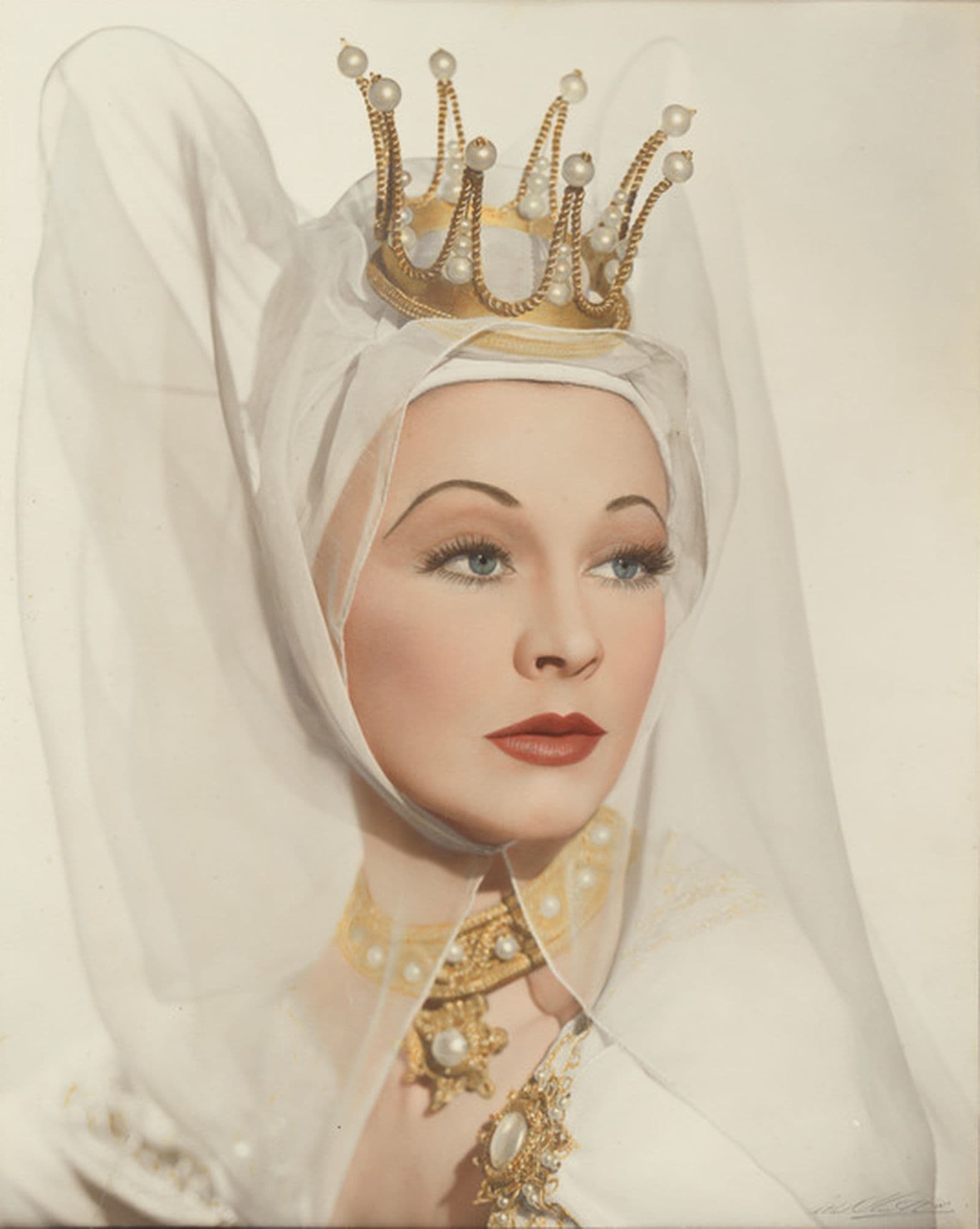
Athol Shmith, Vivian Leigh, 1948, purchased 1986.
About

In the late 19th and early 20th centuries, as the middle-classes expanded in size and affluence, the mass circulation of portrait photographs of public figures and celebrities became an industry. Photographers with talent, technical aptitude, business sense and charming manners found they could become not only specially appointed Court photographers but also the darlings of High Society. Photography defined and created the very notion of celebrity by catering to the public fascination with images of the stars of the stage and later the cinema. Though separated across the globe and in their relative international fame, both Yousuf Karsh (1908–2002) of Ottawa and Athol Shmith (1914–1990) of Melbourne are 20th-century examples of portrait photographers who continued and excelled in the field of providing the public with glorified and glamourised portraits of public figures.
The National Gallery of Australia holds over 130 prints by Karsh and some 60 by Shmith. The Karsh works were acquired in 1973 by the National Gallery’s director at the time, James Mollison, and formed the whole of Karsh’s touring exhibition Men who make our world (although there were female sitters included). Shmith’s works were acquired through purchases from various exhibitions in the 1970s and 1980s when a new era of interest in Australia’s photographic heritage was making an impact, as well as in the form of gifts from the artist.
For sources of inspiration, Karsh and Shmith could take heed of the conventions of painted portraiture going back centuries, as well as the achievements of earlier art photographers. As modern photographers, both men mixed these historical precedents with technical advances such as better lenses, shorter exposure times, panchromatic films (which were more sensitive to the spectrum), electric lighting and an array of special lighting tools for work both in and out of the studio. Throughout their lives, both Karsh and Shmith were drawn to the world of theatre and music, and their experience of stage lighting was critical to their success as portraitists of the good, the great and the gifted.
Curator: Gael Newton, Senior Curator International Photography
The content on this page has been sourced from: Karsh, Yousuf and Athol Shmith. The Good, the Great & the Gifted : Camera Portraits by Yousuf Karsh of Ottawa and Athol Shmith of Melbourne. Canberra: National Gallery of Australia, 2002.
Curatorial Essay
The Vision of Yousuf Karsh and his Photographs of the Illustrious Greats of Japan
There is a brief moment when all there is in a man’s mind and soul and spirit may be reflected through his eyes, his hands, his attitude. This is the moment to record. This is the elusive ‘moment of truth’.
Photographer for 60 years to the famous, the powerful and the talented, Yousuf Karsh’s own eminent position in society was acknowledged in 1999 when International Who’s Who chose him as one of the hundred most influential figures of the 20th century — and the only photographer. Of the other 99 so honoured, Karsh had photographed over half.
The consummate professional, Karsh has been described as ‘a final link to the vision and style of nineteenth-century studio photographers’.2 The seminal influence on his development as a photographer was John H. Garo, in whose studio in Boston Karsh served an apprenticeship from 1928–30 before setting up his own establishment in Ottawa in 1932. Karsh particularly admired Garo’s meticulous, hard-working and business-like approach, and was in awe of his rapport with his clients, his ability to put them at ease.
From this empathetic position, Karsh believed that it was possible to capture something essential about the people he photographed, something that summed them up. What would be summed up though? He was acutely aware of the position in history of his famous subjects, and his own role: ‘How can you possibly photograph an Einstein or a Helen Keller, or Eleanor Roosevelt, a Hemingway or a Churchill, and not realize they are already part of history’.3
What Karsh creates are heroes for our time. His subjects become embodiments of archetypal abstract ideals of goodness and greatness. He sets them apart. They are conduits between the material world and the world of pure thought. A devout catholic, Karsh truly desired to record the soul of his subjects. What he wants to sum up are their achievements in the world of mankind, achievements gained through genius, but also through hard work and with a sense of moral responsibility.
Roland Barthes has commented that ‘the great portrait photographers are great mythologists,’4 and it is here that the secret of Karsh’s success lies. Intuitively Karsh was a brilliant interpreter and author of the stories the public needed to hear. His photographs first became popular in a world torn apart by war, and he became famous in the climate of Cold War tensions and a world increasingly capable of self-destruction. In the face of this Karsh creates a world of certainty and hope. The guys running the show he assures his public are the good guys. His photograph of John F. Kennedy, for example, emphasises a spirituality that possibly few other people would have intuited. Even the guys on the other side are OK really. Nikita Krushchev is seen as some jolly Nanook of the North. Karsh says: ‘here is the face of the eternal peasant, perhaps the collective portrait of a great people’.5 Little to fear.
His photograph of the singer Joan Baez provides another interesting insight into the way in which Karsh chooses to see people and ultimately the world. How does he portray this feisty political activist? Essentially as a latter day saint, her gaze demurely averted, holding a cluster of lilac. Photographing members of the counter-establishment Karsh discovered that ‘while they were young in years, there was about each a deep sense of responsibility and concern and response to the world’.6 Little to fear here either.
Karsh’s vision of the world is relentlessly optimistic. It has been convincingly argued that such an obsessive desire to see good in others stems from his childhood experiences. Born in Mardin, in Armenia-in-Turkey, at age seven he witnessed atrocities as the Turks systematically attempted to force out the Armenian people. Two of his uncles were killed, thrown down a well, and he finally had to flee with his family to Syria taking nothing with him. At fifteen he was sent alone to Canada to his uncle George Nakash, a successful photographer at Sherbrooke, Quebec. But instead of a pessimistic resignation or bitterness, Karsh chose to see good everywhere; and, after such a torrid time, he would take control of everything.
Karsh spent much of his life travelling, photographing famous people all over the world,7 and it should be no surprise that he was drawn to Japan at the end of the 1960s. As a country it embodied the ideals he consistently put forward — through hard work Japan had risen phoenix-like from the ashes of defeat; it revered its great men for their talent; it honoured tradition but was still able to take its place in the quest of mankind toward a better future. A country where the attainment of a refined and controlled aesthetic beauty matters. A country where form and appearances are of outmost importance. All this could not have been closer to Karsh’s heart.
The world was forced to take notice of Japan as a new economic power on the world stage, and Expo ’70 was held in Osaka (with Karsh as photographic adviser). Japanese achievers were given international recognition, being awarded a number of Nobel Prizes — though not for the first time. In 1949 the physicist Hideki Yukawa became the first Japanese to win a Nobel Prize; in 1968 the novelist Yasunari Kawabata was the first Japanese to be awarded the Nobel Prize for Literature; and the physicist Shinichiro Tomonaga also received his Nobel Prize in the 1960s (in 1965).
Since 1950, however, the Japanese themselves had formalised the recognition of distinction by awarding those who were ‘Bearers of Important Intangible Cultural Assets’ (Juyo Mukei Bunkazai Hojisha) with the designation of ‘Living National Treasures’ (Ningen Kokuho).8 Karsh travelled around Japan in 1969 photographing these people ‘treasured by the entire nation’9 in preparation for an exhibition of his photographs that toured Japan in 1970. He also photographed those responsible for leading Japan to economic success.
If Karsh was clearly enamoured of Japan, the feeling was mutual. His exhibition at Expo ’67 in Montreal, Men Who Make Our World, was bought in its totality by the Museum of Modern Art, Tokyo, along with the National Gallery of Australia.
Although Karsh travelled around the world photographing his subjects in their own milieux, his working method allowed him to end up with an almost startlingly consistent result. Early in his career he had been influenced by the lighting employed in the theatre, and he worked always with portable studio lights and large format cameras — lugging 350 pounds of equipment wherever he went. He made the world as much his own domain, and as much under his control, as if he had stayed at home in his studio. While travel freed him from the studio, he was able to remain essentially a studio photographer.
The theatrical and dramatic lighting of his portrait of the liberal politician Yukio Ozaki is often employed by Karsh. Figures appear as if cast from stone, monumentalised and static. Light reveals; and, symbolic of divine light, is often haloed out behind the sitter’s head — contemporary saints. The mood can be sombre, bordering the oppressive.
In his portrait of Ozaki, as well as that of Roppeita Kita, Karsh includes young aides who are there to assist their masters, introducing a mood of tenderness and gentleness. The young girl in the portrait of Ozaki (photographed on an earlier visit to Japan in 1950) leans forward to whisper something into his ear. During the sitting, the grandson of the great Roppeita Kita shouted directions (though in the most respectful way, as Karsh notes in his commentary) to the 95-year-old old Kita10 — one of the most eminent contemporary Noh actors whose unbroken lineage dates back to the late 16th century. All the roles in Noh are played by men. Kita’s most famous role was that of the celestial being, or shite, in Hagoromo (The Feather Robe) who descends from heaven to dance for a fisherman who has found her lost robe.
Moments of such inspiration do free Karsh’s work from cliché and formulaic repetitiveness which he falls into perhaps when the sitter buckles under the pressure of having to take their place in the Karsh pantheon. In his portraits of Japanese people this does not occur. In a world where to be almost deified for one’s achievement seems natural, his sitters seem either indifferent to Karsh’s vision or comfortable with it. There is an uncharacteristic lightness of touch and mood in his Japanese work and I sense a real feeling of empathy. His portrait of the physicist Hideki Yukawa is one of the few I have seen in which the sitter is laughing. Rarely do Karsh’s subjects look like they are having such a good time. Earnestness rather than joie de vivre is Karsh’s usual mode of expression.
Karsh uses the power and recognisable language of gesture to give his audience clues as to how to read his images. He frequently focuses in on the hands of the subject: ‘hands give clues to the entire personality of the subject’s moods, attitude, tension. They are, for me, almost a barometer of a person’s being, a distillation of the whole.’11 It is to Kita’s hands that my eyes return in the portrait; so affected by extreme age, there is a reminder of the transitory nature of time. There is restraint rather than the hyperbole of other portraits where the gesture of the hands may appear contrived and empty.
Hands are also prominent but subtle in the portrait of the Japanese writer, Yasunari Kawabata. The hands gently cradling his face, the eyes reflective, this is a fitting portrayal of a man who devoted the later part of his career to writing what he called elegies (fittingly he is shown with a piece from his extensive collection of Haniwa, early Japanese funerary pottery). Here is a person after Karsh’s own heart — Karsh commenting that Kawabata’s ‘simple literary images linked together produce sudden, profound insight into his characters’ souls’.12 Precisely matching of course what Karsh hoped to accomplish. As always, he looked at his subject and chose to see there the qualities he most admired.
Yousuf Karsh was able to find in Japan and the Japanese people a mirror of his own vision of humanity. The Japanese have a notion of the ‘kami’ or spirit of things; to know the kami of something is to understand its true nature,
its essence. Such notions are close to Karsh’s own statements of what he hoped to achieve in his photographs, though he termed it the soul or the elusive ‘moment of truth’. Japan struck a deep emotional chord in Yousuf Karsh, leading to a profound admiration and appreciation of a culture. Some of the most inspired and moving images of his career were the result.
Anne O’Hehir
Assistant Curator, Photography
1 Quoted in Colin Naylor (ed.), Contemporary Photographers, 2nd edn, Chicago and London: St James Press, 1988, p. 524.
2 Mary Pancer, ‘What makes a photographer great?’ in Dieter Vorsteher and Janet Yates (eds), Yousuf Karsh: Heroes of light and shadow, New York: Stoddart Publishing Co., 2000, p. 218.
3 James Danziger and Barnaby Conrad III, Interviews with Master Photographers, New York and London: Paddington Press, 1977, p. 105.
4 Roland Barthes, Camera Lucida, Richard Howard (trans.), New York: Hill and Weng, 1981, p. 34.
5 Yousuf Karsh, Karsh Portraits, Boston: New York Graphic Society, 1976, p. 98.
6 Ibid., p. 26.
7 Even travelling around Canada filled Karsh with wonder. His wife, Solange, recounted that in 1952 during an assignment for Macleans to photograph the country ‘both of us were as excited and starry-eyed as a couple of babes in the woods … and this attitude remained with us throughout our year long travel’. Jill Delaney, ‘Karsh and the face of Canada’ in Vorsteher and Yates (eds), Yousuf Karsh: Heroes of light and shadow (2000), p. 189.
8 Kodansha Encyclopedia of Japan, Tokyo: Kodansha, 1983, p. 60.
9 Karsh, Karsh Portraits (1976), p. 86.
10 Ibid., p. 106.
11 Karsh, Karsh: A fifty-year retrospective, Boston: Little, Brown and Company, 1983, p. 85.
12 Karsh, Karsh Portraits (1976), p. 86.
Interview
Some of them and some of me
Peter Adams
Great portraits are as much about the artist as they are about their subjects. This is true whether the artist is a sculptor, a painter or a photographer. Successful portraits are invariably not only likenesses of the subject, but also portraits of the artist. In every successful portrait there is always ‘some of them and some of me’.
It is the proportion of this mix that becomes all-important — the balance between the ‘them and me’.
Intentionally or not, photographers are commentators. Most are visually opinionated. If there is too much of ‘me’ in the photograph, then the portrait becomes a story about me. Too much of ‘them’ and the resulting picture will have no opinion. Many photographers want to impose their opinions on the subjects — sometimes doing the subject a great injustice in the process.
In a manner of speaking, our opinions also become our photographic ‘style’. How we think, how we see the world, our attitudes, our beliefs, our personalities, our backgrounds, how we live — all this may be reflected in a portrait. I believe when our opinions overpower the personality of our subjects, the picture becomes a story about the photographer — the subject just becomes an object in front of our lens. For me the best portraits are a blending of both the subject and the photographer — a bit like a conversation where no one dominates and no one shouts.
Perhaps this is the charm of photography — a conversation where no one quite agrees. No two picture-makers think alike. Put two photographers in the same room and we seldom agree on anything — so it is perhaps fortunate that Yousuf Karsh and Athol Shmith never met. If they had, I’m sure their ensuing conversation would have had some interesting dynamics!
Their two personalities were poles apart. Karsh had little formal education. When I met him in 1992 he reminded me of a street fighter — diminutive, pugnacious, domineering and opinionated. Quick movements belying his age ‘I’m 83 in December!’ Throughout my time with him, he never listened, continually interrupted and tried to control my portrait session. Shmith, on the other hand, who was roughly of the same vintage, was educated, urbane, elegant and a great listener. I recall him saying,‘Someone once wrote that the art of listening is as difficult as the art of the orator. Well, in fact it’s harder. So many people just don’t listen.’
It’s most likely that Shmith was unknown to Karsh, even though they photographed many of the same people. It’s probably also fortuitous, because Athol didn’t have much respect for Karsh’s work.
SHMITH: There are one or two photographers I have little time for. One is Ansel Adams — possibly the most commercial photographer who ever lived. He’s not the ultimate ‘art photographer’ proposed endlessly by the Americans, he’s just a commercial photographer who created dozens of duplicated images in his darkroom.
And the other is Karsh.
What’s wrong with Karsh? What a dream of an opportunity he had! To be selected to photograph all those famous people! Fortunately more significant photographers also photographed them because, apart from a couple of portraits, most of his pictures are only skin deep — I mean, the man had to get a couple of shots right with all those great subjects!
In a sense, Karsh’s portraits are like empty buildings. He photographs the persons’ face, not the persons’ soul. His pictures remind me of those Detroit car photos — probably a ridiculous analogy but everything’s just a little too perfect and the end result is rather slick. You are forced to decide what is important about Karsh’s work: his collection of subjects or his collection of pictures.
Someone once said that we are the sum total of everything we have experienced. Perhaps it’s also true to claim that most of our memory banks are filled before we are five years old. Could this be a reason why Yousuf Karsh devoted his life to recording ‘the good the great and the gifted’ — because of his disastrous childhood? Karsh and Shmith couldn’t have come from more different backgrounds. Karsh spent his childhood in Armenia — a tiny country on the border of Turkey, about one tenth the size of the State of Victoria.
KARSH: My father could neither read nor write, but he had exquisite taste and travelled to distant lands where he bought and traded in rare and beautiful things — furniture, rugs, paintings and spices. We lost everything when we were forced to leave Armenia.
Between 1915 and 1922, when I was 14, the Turkish government systematically assassinated one and a half million of my countrymen — roughly one third of the population of Armenia — including most of the intelligentsia and leaders. Even today, 78 years later, the Turks still deny this took place.
Cruelty and torture were everywhere. One of my earliest memories was carrying food parcels to my two beloved uncles who had been torn from their homes and cast into prison by the Turks — for no reason other than they were Armenian. One uncle was a talented artist, a calligrapher who used to illuminate the Bible and the Koran. Eventually they were both thrown down a well and left to perish. There were many similar stories. I remember seeing pictures of beheaded intellectuals and Armenian leaders — these were the people the ‘Young Turks’ went after first.
In 1922 our family was allowed to flee. We had to leave everything behind. We were allowed to take nothing — we escaped only with our lives. We fled on foot — we weren’t allowed to travel by train, which would have taken only two days , instead we journeyed with a Bedouin caravan. The journey to Syria took a month. My parents lost every valuable they managed to save to pay off people along the way. My father’s last silver coin was used to rescue me after I was caught foolishly making a sketch of a pile of human sculls — the last bitter landmark of my country.
I found it hard to relate the words of the dapper little man sitting in front of me — a man who had rubbed shoulders with and photographed the rich and famous, the politicians and personalities from the worlds of acting and the arts for the past 60 years — to his disastrous past. While Karsh was travelling by camel to Syria, Shmith was growing up in Victoria, 12,000 miles away. The son of a Cockney chemist and his Jewish wife, Athol had a happy childhood — surrounded by loving parents and part of a family of three kids.
SHMITH: My father was a chemist — he invented the formula for ASPRO — which later became a multi-million concern after Nicholas bought him out. He could have made a fortune, but never did. I think he made 400 quid out of it! My father was a fine piano player and he instilled in me a great love of music. He also taught me how to play the piano although I always preferred the vibraphone — I bought the first Vibes in Australia.
I wasn’t a particularly good student at school, but I loved music. I played in the school orchestra and with some friends we formed a small jazz group — we were bloody awful but any chance to make some noise — well, we didn’t have to be asked twice! I really wanted to become a conductor. I remember I had a conductor's baton, which came with a set of records called ‘Music for Frustrated Conductors’! I would wait until no one was about, turn up Mozart and Mahler or Beethoven and conduct away to my heart’s content — I did this for years!
Karsh had only a few years of formal education.
KARSH: My early education was primarily in the hands of my mother who was an educated woman and extremely well read — which was unusual in Armenia at that time. I attended a school in Aleppo in Syria for a couple of years after we escaped from Armenia.
Somehow my father managed to scrape together enough money to send me to America, to my Uncle Nakash — a photographer. I continued my education in the States for the next three years — which was difficult because I didn’t speak English — but it was over before it had really begun. Perhaps because of what I had seen, I always wanted to become a doctor but this was not to be.
SHMITH: I really had no intention of becoming a photographer — although I used a camera at school — I really wanted to become a conductor. My first job was in a factory making laxatives — something my father found for me. No experience in life is wasted and I guess I gained some valuable knowledge that was useful later on when dealing with advertising agencies! Meanwhile, I maintained my interest in photography and one day my father got me an assignment through a friend of his who made ball bearings.
Sixty years down the track and much had changed in the fortunes of these two men.
I remembered the Château Laurier where Karsh lived and worked. Built in 1884 and named after the first French-speaking premier of Canada, it reminded me of a pretentious chateau on the Rhine. It had heavily ornate, sumptuous rooms connected by wide corridors, hideous carpet punctuated here and there by alternating busts in white marble on mahogany plinths, and tired-looking pots of aspidistra and palms.
One expected to encounter the obligatory suit of armour around the next corner — it seemed an incongruous backdrop for the pugnacious Karsh, who had started off in such desperate surroundings. I felt this was a heritage earned, rather than one inherited.
The home of Athol Shmith was in complete contrast.
If one recalls the fashion pictures and portraits of Athol Shmith from the 1930s, 1940s and 1950s, it’s not hard to imagine the dapper young photographer, driving around Melbourne in his black MG — the first one in Australia. In comparison with Karsh, Athol Shmith lived a privileged life, in a fantasy world filled with beautiful socialite women, celebrities and elegance and light.
I first met Athol in 1986. The front door of his tiny duplex apartment in South Yarra opened bringing me face-to-face with a neatly groomed man wearing a well-cut jacket and slacks. I was instantly reminded of a 1950s picture of a gently stooping Athol by Helmut Newton, with whom he once shared a studio.
I entered his home. Gone at once was my fantasy. The imagined light and elegance was replaced by dark timber, concrete brick walls painted a sombre mustard colour, dingy lighting and dark furniture — lighting so low I couldn’t get a reading on my light meter. Why were the 1970s such an ugly period in Australian architectural design?
Shmith’s major influences in photography were music and his father — who didn’t discourage him from following a musical career, but definitely did encourage him to tackle photography assignments for his friends.
Shmith’s love of music and photography were equal. His arms would move about like a conductor as he would speak of conducting a photography assignment, or the need for composition and symphony in a photograph. He would argue for movement and scale and pitch in a print. He would try to explain to colleagues the relevance of counterpoint and contrasts, of scales and tonal ranges. He invariably played classical music while he was working and watching him work has been described by some to be like watching a ballet.
Athol would be moved into making a photograph.
SHMITH: There’s an interesting parallel to be made between photography and music. In the history of music, it is the composer who will be remembered. I wonder how many performers have played Beethoven’s Fifth since he wrote it? I wonder how many performers will be remembered a hundred years from now?
With photography the opposite is true.
It will be the image that is remembered — long after the photographer’s name has been forgotten. When we talk about Eddie Adams’ picture of the Vietnamese General shooting the Viet Cong in the head, we talk about the picture not about Eddie. In the case of photography we always talk about the score — seldom about the composer.
There were three major influences in the life of Karsh. The first was his mother who instilled in him the value of tolerance and determination. PerhapsKarsh’s instinctive desire to show human greatness in terms of social contribution — rather than destruction — was a way of restoring a balance to the world of his early childhood. His mother’s philosophy of ’always turn the other cheek’ would certainly have found fertile ground in the mind of the young Karsh. The second influence was his mentor and fellow Armenian John H. Garo, a portrait photographer in Boston, to whom Karsh was apprenticed.
KARSH: Garo was a wise counsellor. He encouraged me to attend evening classes in art and to study the work of the great masters, especially Rembrandt and Velázquez. I never learned how to draw or paint but I did absorb a fair amount about lighting, composition and design.
The third major influence on Karsh’s life, and the one that probably determined his distinctive repetitive photographic style, was his love of the theatre. In his early days in Ottawa, Karsh had few friends and welcomed an invitation to join the Ottawa Little Theatre, an enthusiastic group of amateur players.
KARSH: The experience of photographing actors with artificial light overwhelmed me. Working with daylight in Garo’s studio one had to wait — sometimes for hours — for the light to be right. With artificial lighting, moods could be created, modified, intensified. A whole new world was opened to me.
It was perhaps this influence of ‘stage lighting’ that so profoundly determined Karsh’s photographic style. Many of his best-loved images — for example the portraits of Hemmingway and Khrushchev appear to have been made in his studio, but in fact were made on location.
KARSH: My portable lights gave me the freedom to work away from Ottawa. Any room in the world where I could set up my lights and camera — from BuckinghamPalace to a Zulu kraal — became my studio.
One is forced to ask why anyone would travel all the way to Key West or Moscow and return with an image that appears to have been made in a studio in Boston!
Photographing Karsh was a nightmare! Perhaps when a person has lived through a disastrous childhood like his, it becomes impossible to let go — to hand control over to someone else.
Photographing Athol was a breeze. I photographed Athol in his cluttered office on the mezzanine floor. How he managed to cram a large desk and all his other junk into a space 1.8 metres square is hard to imagine — until one realises there is very little of Athol’s photography still in existence.
In a manner of speaking, this tiny space was the personification of all that remained of his 50 years as a photographer. While his peers — Dupain, Cato and others — meticulously filed and numbered every job they photographed, Athol believed his old commercial negatives were of no particular value and he trashed them all.
Fortunately, an enlightened Gael Newton discovered a pile of them in 1970 in a garden shed belonging to one of Athol’s old students — the filmmaker Paul Cox. ’I shovelled them into a suitcase,’ (her words, not mine), ’and took them to the National Library and the Art Gallery of New South Wales’.
The pictures reproduced in his two books were rescued from these suitcases, boxes in people’s garages, private collections, and a few — a very few — from the photographer himself.
Athol pointed to a framed picture of Judy Garland hanging on a wall.
SHMITH: That’s my all time favourite picture! Such a sad picture. I couldn’t bring myself to make a final print. I destroyed the negative right after I made the work print — that’s the work print up there. I couldn’t tear it up, but I did score it [the negative] and threw it away once I saw the work print. Technically it’s lousy. It’s over contrasty. It’s not even sharp. Everything’s wrong. Now why is it that everything can be wrong with a picture and yet everything can be right?
It was a depressing moment — Garland was drunk and had kept the audience waiting for over an hour. It makes me depressed looking at it. She was abusing me at that moment for taking the picture. Yet, when she started singing, it was magic!
Garland never saw the picture — it seemed an invasion into her life.
I was very fortunate. Starting in the 1930’s I had a contract with the ABC to photograph visiting celebrities. I had no idea at the time just how fortunate I was! They would phone up and ask me to photograph Thomas Beecham, or Malcolm Sargeant, or H. G. Wells, or whoever — mind you, I had a similar contract with J. C. Williamson who brought out people like Yehudi Menuhin. I was bloody lucky, I had no competition! I did ‘aunty’s’ publicity work for nearly 30 years.
I wish those negatives existed today — just imagine the record that no longer exists!
Karsh hated being photographed. He immediately started organising me: how and where he wished to be photographed, what he should wear, which hat — he was already wearing a beautifully tailored suit and tie. ‘The light is beautiful at the moment! We should talk as we walk because if you leave it too late, it won’t be as good. We will do the shot in ten minutes outside Parliament House. This tie OK? Do you like this hat?’ He held up battered felt Trilby, "’Or this one?"’ This time a natty black one. He tried on both, all the while checking the results in a mirror. He made the decision. Natty was better.
‘It’s three degrees outside.’ The final touch was a hideous long coat made from dead animals. ‘I’ll give you a 15-minute start and follow you — I don’t want to stand around while you decide what you want me to do.’ To Jerry Fielder, his assistant: ’Take him to the archway — there’s a view of Parliament House through the archway. We’ll do the shot there.’
The last thing I needed was another picture of a photographer standing in an archway. But I said nothing. Leaving Karsh in his studio, we set off up the hill.
The entrance driveway to Parliament House in Ottawa is designed like an inverted ‘U’, with buildings on three sides and a large open lawn in the middle. It was February and the lawn was covered in snow — not a footprint in sight.
I hate pre-conceiving images, but I thought it would be terrific if the old man’s footsteps appeared in the top left-hand corner of my picture and led towards my camera — about 100 yards away. The old man arrived. He agreed. ‘But I have the wrong shoes!’ This to his long-suffering assistant, ‘I need my boots — my black leather boots. Go back to the studio and fetch them. Meanwhile he can photograph me here under this archway.’
The bloody archway again! Controlling, always controlling.
Stiff and awkward in front of the camera, I moved him about as much as I dared, but there was no subtlety of movement and he was as stubborn as an ancient mule. I wondered if this was simply the behaviour of an ‘Old Chooker’ or something to do with his sudden loss of being ‘in control’.
I was determined not to photograph Karsh as he wanted. At that moment, two spunky women walked past and he started being cheeky to them. He turned away from me to talk to them. Now in profile to me, he momentarily forgot all about me as he watched them pass out of sight.
He suddenly seemed small and insignificant and lost in thought.
It’s extraordinary what one notices in moments such as these. I remember thinking how huge his nose was and how it seemed to have the same texture as his coat — all lumpy and shapeless. I tilted the camera up to reinforce the sensation of insignificance and make the concrete around him more overpowering. I have no idea what he was musing about. He never said. The moment lasted only a moment, but long enough to make a few exposures before he turned back to me and started to tell me what to do again.
While there is only a limited collection of Athol Shmith’s work still in existence, Karsh left the world with an astounding record of the rich and famous over the past 60 years. His was a way of making pictures that flattered the subject, so they felt comfortable posing for him. Being photographed by Karsh became an entry fee to an exclusive club where your credentials were endorsed by the other great and famous people who had already been before his lens. A Karsh portrait became, if you like, the final accolade of recognition from the world stage.
After the success of his 1941 portrait of Churchill, Karsh never had a shortage of subjects; indeed, being photographed by him became — as one critic has described it — ‘a badge of honour’.
We are now a different generation of photographers. We live in an unflattering world filled with fear and exaggerated rhetoric. We have come to the uncomfortable realisation that Australia can no longer have an island mentality — protected and isolated. We have begun to realise that if we wish to become a part of the World Stage, we can also expect the occasional pratfall. We have discovered it is our inalienable right to question the platitudes of the politicians and religious leaders we once held in reverence.
When viewed in today’s sceptical light, Karsh’s work poses a few questions. These can only be answered on an individual basis — from our personal viewpoint and backgrounds as students of photography.
For example, is Karsh’s legacy to the world a collection of truly great photographs?
One definition of a portrait might be that it should give some insight into the person’s personality, life and character. In all honesty, what can we really tell about the people Karsh photographed that we didn’t already know from media, films and the like?
Would it be fair to say that while Shmith’s portraits may be ‘softer’, they also give us greater insight into the character of his subjects? Does the rawness of his Judy Garland picture, for example, make us understand her pain better — or would we still prefer to remember her through the glossy spectacles of a Hollywood illusion?
An illusion is, after all, in reality, a lie.
As another example, both Karsh and Shmith made portraits of Sir Laurence Olivier. Both pictures were made in the classical style of the period. Both photographers used tungsten light. Both had Olivier holding something. Both photographed him over his left shoulder, looking from right to left. Why then does the Karsh picture look so soppy, uncomfortable and ‘mincing’, while the Shmith portrait seems to record an intelligent, strong and engaging actor?
Perhaps it’s more accurate to say that the Karsh collection is a great record of the world’s celebrities — but is it really a collection of great photographs?
If every successful portrait is ‘some of them, and some of me’, would it be true to say that most of Karsh’s portraits are portraits of him — in that most of the lighting and posing are the same? How could this extraordinary collection of people all be the same?
We may feel we already know the celebrities Karsh photographed from what we have been exposed to in the media. Perhaps we love them. Perhaps we hate them — but why is it that we feel comfortable when we see them? Perhaps it’s a bit like discovering there’s someone else in the world that feels the same way about them as we do? When we look at his portraits, what are we judging? The personalities? His photography? Ourselves?
In 1992 Karsh told me, ‘It should be the aim of every photographer to make a single exposure that shows everything about the subject.’ After a pause, he added, ‘I have been told that my portrait of Churchill is an example of this.’
I confess, I find it impossible to accept that any single image can come close to representing everything about a person — even Karsh’s best-known image of Winston Churchill. I prefer instead the words of another great American portrait photographer, Arnold Newman, who in the same year said: ‘I am convinced that any photographic attempt to show the complete man is nonsense. We can only show, as best we can, what the outer man reveals. The inner man is seldom revealed to anyone, sometimes not even the man himself.’
However, on one point I do agree with Karsh: ‘When you photograph an Einstein, or a Helen Keller or a Hemmingway, or a Churchill, you are already a part of history. If your photograph is the summation of these persons’ many accomplishments, then the historical point of view is already fulfilled.’
Athol Shmith used to advise his students not to live by photography alone, but to explore all the arts. That’s also my philosophy. Photography is still the youngest of all the arts, and sometimes the most raw.
SHMITH: With good portrait work you must satisfy yourself. If you set out to satisfy your subject or your client, you’ll find yourself getting rid of all the bloody wrinkle lines. I always talk to my subjects before I make a shot. There’s an old trick called ‘doing the mahogany’ — where you pretend to pull out the slide and then people would stiffen up. You’d pretend to make an exposure and then you’d pull the slide when they aren’t expecting it and then make your exposure.
I can’t make portraits before an audience. I can do advertising shots before an audience. The more the merrier! The whole damn Victorian advertising club can be there for all I care! But not with a portrait. For a portrait I need to be by myself.
I have no regrets about the work I did — except that I didn’t keep negatives. It’s no big thing — what’s the use? If I started worrying abut it I’d become melancholy! They’ve gone — but it was one hell of an experience while I was doing it.
Of the millions of images that will be made today and tomorrow, few will stand the test of time. If photography is all about capturing tiny moments of time then perhaps time itself will be photography’s only true critic. Shmith and Karsh may have given us a romanticised view of ourselves — perhaps a view that was not totally honest, in that at the time they were made, we may not have been ready for the cold hard facts of reality — but certainly a view that will be remembered.
Artists
Yousuf Karsh
Yousuf Karsh, who died in Boston in July 2002 aged 93, is popularly known as the great camera portraitist of the most esteemed world figures and celebrities of the mid to late 20th century. His subjects included politicians, religious leaders, royalty, artists, writers, dancers, actors, singers, musicians, explorers, scientists and physicians. Born in 1908 to Armenian parents in Mardin, Turkey, Yousuf Karsh had first-hand experience of political strife when the Turks persecuted his family. Travelling alone across the world in 1924 at the age of sixteen, Karsh was able to immigrate to Canada where his uncle, George Nakash, had a portrait photography studio in Quebec. Karsh first trained with his uncle and then in Boston in the portrait studio of fellow Armenian John H. Garo. Karsh moved back to Ottawa in 1932, where he established his own studio. From the 1970s until he retired in 1994, Karsh had his studio in the lavish Chateau Laurier, a landmark building in the best street in Ottawa. Karsh’s mentor, John Garo, had made rather soft, idealised romantic portraits in the prevailing style of art photography, but Karsh developed his own modern look with dramatic, sharp and strongly lit close-ups. Karsh’s experience with stage lighting as a member of the Ottawa Little Theatre was a factor in his technique, and through this theatrical circle he made political and social contacts that led to clients for his business.
From as early as 1936 Karsh was becoming known for his modern portraits of visiting statesmen and dignitaries, who were often set against a darkened background, spot-lit like actors on a stage, and shown close-up revealing every detail of hair, skin and clothes. He used large format cameras with up to 8 x 10 plates and huge banks of lights to transform his subjects. Karsh’s international reputation was made when his portrait of British prime minister Winston Churchill — then in Ottawa for a political meeting during World War II — was used on the cover of Life magazine in December 1941.1 According to legend, Karsh whipped Churchill’s beloved cigar out of his mouth a moment before making his exposure. (By contrast Karsh would later persuade the formidable USSR leader Nikita S. Khrushchev to don his native headgear of a Siberian fur hood and smile like a jolly Santa Claus.) The portrait of Churchill became the iconic image of the wartime leader and was even the model for his portrait in Madame Tussaud’s wax museum in London. Churchill is not ‘scowling’, as the image is so often described, and its success surely had more to do with making the not very photogenic Churchill exude the right mix of concern, bullying strength and vision. These were the qualities then needed to reassure the public across the Commonwealth as they faced their enemies in Europe.
Although Karsh credited his beloved mother with being an inspiration to his work, he did not return to Armenia until late in life. From the time of his success with the Churchill portrait, Karsh did, however, spend much of his life travelling across the world to photograph the good, the great and the gifted among world figures, or ‘people of consequence’ as he called them. He produced numerous publications, beginning with Faces of Destiny in 1946. Signing himself ‘Karsh of Ottawa’, the photographer became a celebrity in his own right and world leaders felt slighted if not selected to be ‘Karshed’. In many cases Karsh’s camera portrait became the best known image of the subject. Karsh, a devout Catholic, had a belief in individual greatness and in role models in society. This was perhaps fuelled by his knowledge, gained early in life, of how cruel human beings could be to each other. Although his sitters were mostly commissioned portraits, there is a sense in which Karsh put his own imprimatur on a pantheon of well-known people whom he saw as deserving of their fame through merit, not birthright. He did not ‘do’ glamour per se and his female subjects are handsome rather than ‘fair ladies’. Stories abound about how Karsh managed to get his subjects to co-operate, regardless of the location or how short a session he might have been allocated. As one critic commented, ‘Clearly Karsh used a lot more than lighting on his subjects. His conversational foreplay was as spontaneous as his portraits were staged.’2 Karsh also developed a distinctive style of dark, dramatic, large exhibition prints up to a metre in width or height (as shown in this exhibition) with startling depth and detail. Karsh’s photographs were the equivalent in the portrait field to the monumental landscape photographs of his American contemporary Ansel Adams.
Yousuf Karsh was at the height of his career in the 1960s and 1970s when he was the star of the Canadian pavilion at the World Expo ‘67 in Osaka. Several large exhibitions of his work toured internationally in these years. By the time he died in 2002, Karsh had been awarded an Honorary Fellowship of the Royal Photographic Society and almost every possible form of recognition from his photographic peers across the world. He received national and international honours including an award as Officer of the Order of Canada and a number of honorary degrees from Canadian and American universities.
Gael Newton
- The Canadian Government then sent Karsh to London to photograph the other leaders of wartime Britain and Life magazine commissioned portraits of American military leaders.
- Sarah Boxer, ‘An Understanding of How to Picture Fame’, The New York Times, 11 August 2002, p. 31 (a review of Karsh works at Yancey Richardson Gallery, New York)
Louis Athol Shmith
The only Australian in the Karsh collection is a portrait of expatriate Sister Kenny, who developed treatment regimes for poliomyelitis. Karsh had most likely never heard of his contemporary in Melbourne, Louis Athol Shmith, who was something of a legendary character in his home city. Shmith was born in Melbourne in 1914 and came from a comfortable and cultured middle-class family; his father was a respected chemist and a fine pianist. Athol Shmith played the vibraphone and considered music as a possible career. His father gave him a camera as a teenager and what was a hobby became a profession in his late teens when Shmith, who had an interest in theatre and played at charity performances, was asked to take the publicity photographs and stills for a show. He saw there was a career in his former hobby and, supported by his family, established a studio in St Kilda. For the first five years he specialised in theatre work and society and wedding portraits. In 1939 he moved to a studio in Collins Street (where all the best photographers were located), run with the assistance of his brother and sister. Shmith first made his reputation with society weddings and portraits, but his professional break came in the early 1930s when he gained the contract to take portraits of visiting celebrities for the newly formed Australian Broadcasting Commission. Shmith’s work expanded to include a range of commercial advertising and illustration and appeared in local society magazines. He exhibited his works in photographic salons at home and abroad, gaining a Fellowship of the Royal Photographic Society in 1933. He also held an appointment as Vice Regal Photographer in Melbourne and had the contract for work for theatre producer J.C. Williamson.
Influenced in his early career by the soft impressionistic style of turn-of-the-century art photographers, Shmith later embraced the clearer light, bolder compositions and design emphasis of modernism. By the late 1930s he was seen as representing a new modern style of work. After World War II Shmith embraced the New Look and the spirit of post-war recovery in fashion illustration, becoming the most respected professionalin the field in Australia. Throughout the 1960s Shmith remained energetic and dynamic in his development of fashion work. By the close of the decade Shmith began to take on roles in photographic heritage and education. In 1968 he helped to establish a photography department at the National Gallery of Victoria and in 1971 closed his business1 to take on a new role as head of the Photography Department at Prahran College of Advanced Education. Until ill health caused his retirement from the College in 1979, Shmith was a significant support to the rising generation of documentary and artist photographers such as Carol Jerrems and Bill Henson. Shmith’s work was largely based in his home city of Melbourne.
Athol Shmith’s photographs created a world of grace, glamour and allure. In later life Shmith undervalued his own commercial work but, under the new wave of interest in photography as art, Shmith’s work was collected by the major art museums in the 1970s and 1980s and he had a retrospective in 1977 at the Australian Centre for Photography. He was made a member of the Order of Australia in 1981. A small monograph on his work was published in 1980 and a more substantial one was written by curator Isobel Crombie and published in association with his major retrospective at the National Gallery of Victoria in 1989.
Athol Shmith was, like Karsh, urbane, charming and witty but possibly more madcap. Shmith was less concerned with the gravitas and moral exemplar of ‘greatness’ than with the imparting of elan, style and creative spirit. He was fascinated with his subjects rather than in awe of them. Even though his subjects are most often in a soft and more sensuous focus than the robust men and women in Karsh’s world, they often seem closer to the viewer. Shmith, who prided himself on his skill in lighting, had learned much from the model of European modernism and the quirkiness of surrealism. He was also indebted to the top-lit and back-lit glowing ‘Hollywood lighting’ style of portraiture popularised by Californian photographer George Hurrell in the 1920s and 1930s. He described his portrait of actress Vivien Leigh in costume as lit by his ‘inky dinky light’, a top spotlight diffused by tracing paper. Where Karsh made even beautiful women look strong, Shmith treated his female sitters and models as princesses.
Athol Shmith did know about Yousuf Karsh but thought his photographs made the subjects look like ‘empty buildings’.2 Both Karsh and Shmith shared an equal passion for their medium of expression. The development of a more rarefied photographic art scene in museums and a new scepticism among the young towards authority figures from the 1960s on led to their styles of work being seen as outdated aesthetically and politically. While different in their mood and approach to the portraiture of the good, the great and the gifted, Karsh and Shmith excelled at their work, and their passion for photography was inextricably linked to the passport the medium gave them to wider and more exotic worlds. Both Karsh and Shmith have extensive holdings in the collection of the National Gallery of Australia.
Gael Newton
- Operated since 1950 in association with John Cato, son of Melbourne photographer and photo-historian Jack Cato.
- In an interview with Peter Adams in 1986, Shmith said: ‘In a sense, Karsh’s portraits are like empty buildings. He photographs the person’s face, not the person’s soul. His pictures remind me of Detroit car photos — probably a ridiculous analogy, but everything’s just a little too perfect and the end result is rather slick. You are forced to decide what is important about Karsh’s work: his collection of subjects, or his collection of pictures.’
Touring Dates and Venues
This touring exhibition was sponsored by Australian Air Express.
- Monash Gallery of Art, Melbourne, VIC | 7 February – 30 March 2003
- Gold Coast City Art Gallery, QLD | 17 April – 29 June 2003
- Rockhampton City Art Gallery, QLD | 25 July – 7 September 2003
- Swan Hill Regional Art Gallery, VIC | 26 September – 9 November 2003
- Orange Regional Gallery, Orange, NSW | 21 November 2003 – 25 January 2004
- Gosford Regional Art Gallery, Gosford, NSW | 6 February – 21 March 2004
Related
The Art of Photography 1839–1989

17 Jun 1989 – 27 Aug 1989

A Decade of Australian Photography 1972 – 1982
Philip Morris Arts Grant at the Australian National Gallery

8 Oct 1983 – 29 Jan 1984

Published 15 November 2023
Poster Art In Australia
5 Nov 1993 – 6 Feb 1994
Recent Australian Photography
From the Kodak Fund
05 Oct 1985 – 09 Feb 1986